All four Lisbon dolphin tours are rated 4.9 and all four put a marine biologist on the boat, so neither tells you anything. What separates them is which water you sail, how many people share the boat, and how many guests have actually been.
What You Should Know
- The star rating cannot help you here. Every listing leads with 4.9 and a marine biologist on board, and those are precisely the two things that do not separate these tours. Read the review count, the departure point and the boat instead.
- Three of the four sail from Lisbon and one does not. The cheapest at €50 leaves from Sesimbra, an hour south, and booked with the transfer it runs from an early Lisbon pickup to roughly 14:30. You are saving €15 and spending about four extra hours to do it.
- The 97% sighting figure on several of these listings is the operators' own number rather than an independent one, and none of them promises a refund for a blank trip. Treat it as a track record, not a guarantee, and book early in your stay so a blank morning can be repeated.
- These are small fast boats with no toilet on board. A rigid inflatable or a Zodiac for two to three hours is a bumpy, exposed, spray-in-the-face ride, which is fine for most people and genuinely unsuitable for some. Operators do provide for it better than the listings suggest: one issues waterproof jackets and trousers and opens toilets before boarding, and another carries motion-sickness tablets. Ask rather than assume, and go before you board.
- All three Lisbon tours leave from the same dock, Doca de Santo Amaro, at the same €65, so you are choosing an operator rather than a product. What genuinely differs is how many people share the hull: sixteen per boat on one, up to twenty-four on another, and no published figure at all on the third.
Dolphin Tours in Lisbon
A dolphin tour in Lisbon is an easier booking than it used to be. A few years ago the honest answer to "can I see dolphins from Lisbon" was to drive an hour south to the Sado estuary, where Portugal's only resident bottlenose population lives. Today three of the four tours compared here sail from Doca de Santo Amaro, ten minutes from the city centre, with marine biologists on board and enough demand between them to support thousands of reviews.
What has not changed is that the listings are close to identical. Every one of these is rated 4.9. Every one advertises a biologist. Every one quotes a sighting rate in the high nineties. This page compares them on the things that actually differ: which stretch of water you sail and therefore which species you are likely to see, how many people share the boat, what happens before you board, and how much evidence sits behind each of those 4.9s. If you would rather be on the water for the light than the wildlife, our Lisbon sunset cruise guide compares the evening sailings, where dolphins turn up as a bonus rather than the point. For other full days out of the capital, our Lisbon surf lesson guide covers the Caparica and Carcavelos beaches, and our Lisbon to Porto day tour guide compares the long drives north. For sightseeing on the Tagus itself, our Lisbon boat tours comparison covers the river cruises and private charters, families should see our guide to Lisbon with kids, and everything else is ranked in our best things to do in Lisbon guide.
Lisbon: Dolphin-Watching Ocean Safari with Marine Biologist
All four tours here hold 4.9, so the tiebreaker is evidence, and this one has 2,166 reviews against 1,210, 268 and 54. Two to three hours on a fast RIB from Gate 3 at Doca de Santo Amaro, with two marine biologists, departures in five languages, motion-sickness tablets aboard and children from five. The honest tradeoff is capacity: it takes up to 24 where its neighbour on the same dock caps at 16 per boat.
Book NowBest Lisbon Dolphin Tours: Side-by-Side Comparison
| If you want | Book |
|---|---|
| The most evidence behind the rating | SeaEO Tours, €65, 2,166 reviews |
| The smallest boat, and toilets before you board | Terra Incógnita, €65, max 16 per boat |
| The lowest price | Vertente Natural, €50, from Sesimbra |
| To sail the water the resident bottlenose pod uses | Vertente Natural, €50, Arrábida and Sesimbra |
| To be back in Lisbon by lunchtime | Any of the three Lisbon departures |
| A tour in a language other than English | SeaEO Tours, which runs in five |
| Tour | Price | Online Rating | On the Water | Departs | Boat | Max Group |
|---|---|---|---|---|---|---|
| Our Pick Dolphin-Watching Ocean Safari with Marine Biologist SeaEO Tours Book Now |
€65 | ⭐ 4.9 (2,166 reviews) Read Reviews |
2 to 3 hrs | Doca de Santo Amaro, Gate 3 | Fast RIB | 24, ages 5+ |
| Dolphin Watching with Marine Biologist, Small Group Terra Incógnita Book Now |
€65 | ⭐ 4.9 (1,210 reviews) Read Reviews |
2.5 to 3 hrs | Doca de Santo Amaro | Speedboat | 16 per boat, ages 6+ |
| Sesimbra Dolphin Watching, Fast Track + Marine Biologist Vertente Natural Book Now |
€50 | ⭐ 4.9 (268 reviews) Read Reviews |
2 to 3 hrs | Porto de Abrigo, Sesimbra; Lisbon transfer optional | Zodiac | 30, ages 2+ |
| Lisbon Dolphins Ocean Safari with Marine Biologists Seaview Nautical Events Book Now |
€65 | ⭐ 4.9 (54 reviews) Read Reviews |
2.5 to 3 hrs | Doca de Santo Amaro, Alcântara | Fast RIB | Not published |
ℹ️ How we ranked them: we compared the four current listings, checked each operator's own website for durations, boats, group caps and departure points, and weighted the review count rather than the star rating, since all four sit at 4.9. Listings checked on September 9, 2026. Prices are the per-person from-price in euros. "On the water" is boat time, not the length of the day: the Sesimbra option booked with a transfer runs from a Lisbon pickup to a roughly 14:30 finish. Three of the four publish a minimum age, at two, five and six years; the fourth publishes nothing, so ask before booking a family on. One caveat on the caps: the sixteen is per boat, and a busy departure there can run two boats, so the number sharing your dock is not always the number sharing your hull.
Compare the Most Popular Lisbon Dolphin Tours
Three of these sail from Lisbon and one from Sesimbra an hour south, at €50 to €65. Compare them on the boat, the dock and the review count rather than the score. Check live dates below.
Book Our Top Pick Directly
Live availability for our top pick, which carries by far the largest review base of the four at 2,166. Pick your date below.
- Free cancellation 24h
- Reserve now & pay later
- Two marine biologists on board
- Departures in five languages
- Children from age five
- Motion-sickness tablets carried on board
- Doca de Santo Amaro Gate 3, ten minutes from the centre
- Takes up to 24, more than the 16 next door
- No refund if no dolphins are sighted
We may earn a commission on bookings made through this widget — at no extra cost to you.
What to Expect on a Lisbon Dolphin Tour
A typical Lisbon dolphin tour, from the dock to the return.
- 01Check-in
At the dock
All three Lisbon departures use Doca de Santo Amaro, under the 25 de Abril bridge, so check the gate and the operator rather than just the dock. One starts you in a lounge with coffee and pastéis de nata and, more usefully, toilets. Use them: there are none on the boat.
- 02First 15 min
Briefing and lifejackets
A safety briefing, lifejackets and a short talk from the biologist on what you might see and how the boat will behave around it. One operator issues waterproof jackets and trousers at this point, which is worth knowing before you spend money on a jacket you did not need.
- 03~30 min
Out of the Tagus at speed
Down the estuary past Belém and out into open water. This is the fast, bumpy, wet part and the reason a rigid inflatable is not for everybody. Sit toward the back if the impact bothers you.
- 04~1 hr
The search
Engines down, everybody scanning. This is most of the tour and the part nobody photographs. Seabirds working the surface are what the crew are watching for, since they mark feeding below.
- 05~1 hr 30
A sighting, if the day gives you one
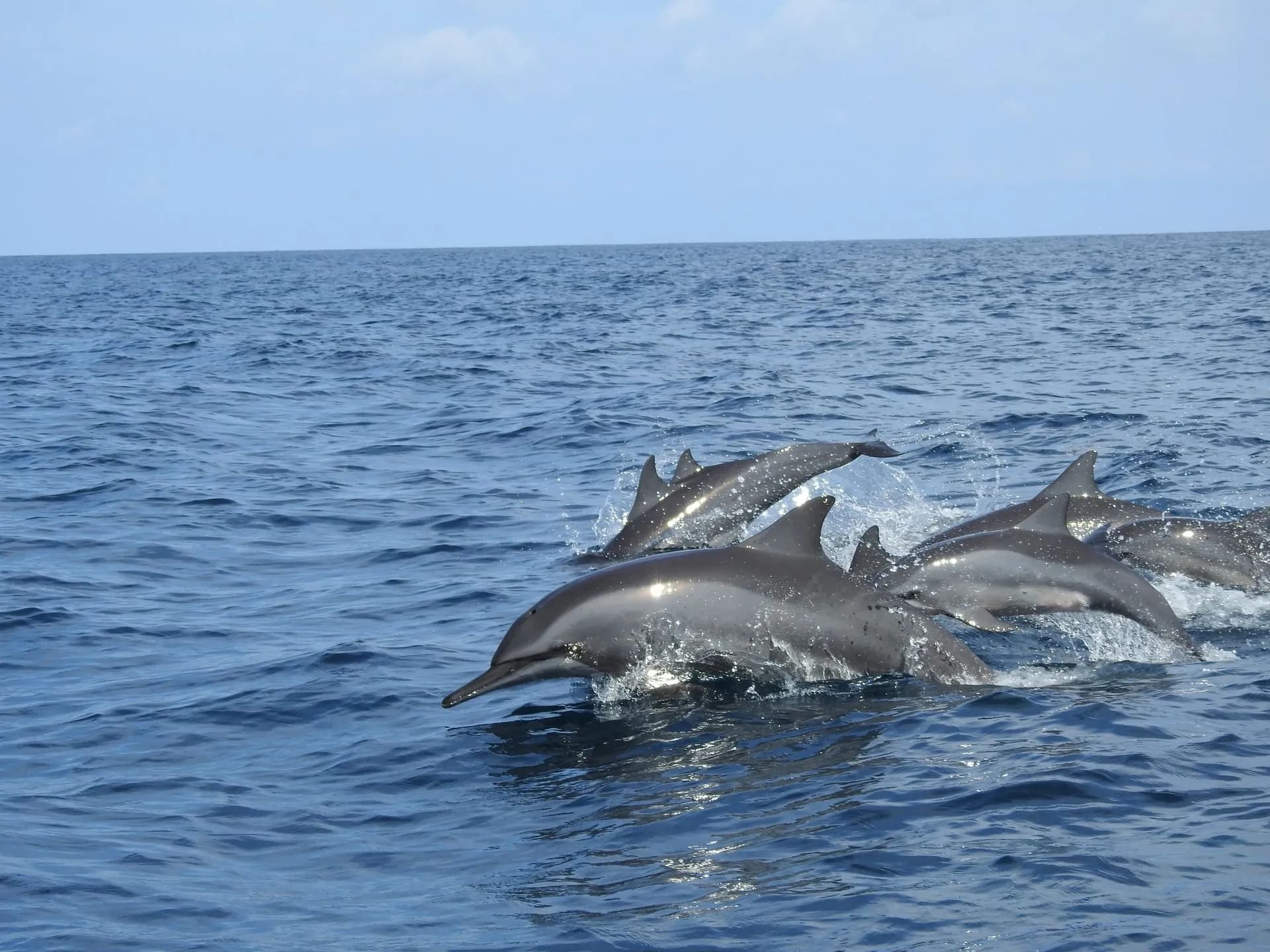
The boat holds its distance and lets the animals approach. Common dolphins often bow-ride, which is when everyone gets their photograph. Some trips find a large travelling group and some a brief surfacing at distance.
- 062 to 3 hrs
Back to the dock
Back up the estuary and alongside, with the rest of the day intact if you sailed from Lisbon.
- 01
At the dock
All three Lisbon departures use Doca de Santo Amaro, under the 25 de Abril bridge, so check the gate and the operator rather than just the dock. One starts you in a lounge with coffee and pastéis de nata and, more usefully, toilets. Use them: there are none on the boat.
Check-in - First 15 min02
Briefing and lifejackets
A safety briefing, lifejackets and a short talk from the biologist on what you might see and how the boat will behave around it. One operator issues waterproof jackets and trousers at this point, which is worth knowing before you spend money on a jacket you did not need.
- 03
Out of the Tagus at speed
Down the estuary past Belém and out into open water. This is the fast, bumpy, wet part and the reason a rigid inflatable is not for everybody. Sit toward the back if the impact bothers you.
~30 min - ~1 hr04
The search
Engines down, everybody scanning. This is most of the tour and the part nobody photographs. Seabirds working the surface are what the crew are watching for, since they mark feeding below.
- 05
A sighting, if the day gives you one
The boat holds its distance and lets the animals approach. Common dolphins often bow-ride, which is when everyone gets their photograph. Some trips find a large travelling group and some a brief surfacing at distance.
~1 hr 30 - 2 to 3 hrs06
Back to the dock
Back up the estuary and alongside, with the rest of the day intact if you sailed from Lisbon.
All four follow the same shape: check in at a dock, a safety briefing and lifejackets, a fast run out to open water, then a slow search with the engine cut whenever something is found.
Our take (the advertised duration is a floor, not a ceiling): These are listed at two to three hours, and guests regularly describe three and a half or closer to four, because a crew that has not found anything keeps looking rather than turning for home. That is the right instinct and it is also a planning problem. We would treat a morning departure as taking the whole morning and leave the slot afterwards empty rather than booking lunch against it.
Who these tours suit less well
- Anyone who should not be jolted. These are rigid inflatables and Zodiacs, not cruise boats. You sit on a tube or a bench and the ride out is fast and hard across chop. Back and neck problems, recent surgery and pregnancy are all genuine reasons to check with the operator first.
- Anyone prone to seasickness. The Atlantic outside the Tagus mouth is open water, and the search phase means sitting still in swell, which is the part that catches people out. Take something before boarding rather than when you feel it. One operator does keep tablets on board, but by then it is usually too late.
- Anyone who needs a toilet within three hours. There are none on these boats. Two of the Lisbon operators open facilities at the dock before departure, so go before you board rather than assuming there is somewhere to go after.
- Anyone who wants a guarantee. The high sighting figures quoted are the operators' own, and the published terms do not promise a refund for a blank trip. This is where operators really differ in practice: guests describe one crew offering a free repeat trip after a tour found nothing, another refunding people who would rather not sail in bad conditions, and a third declining outright. None of that is policy you can hold them to, so ask before you pay and book early enough to try again.
- Very young children. Three of the four publish a minimum age, and they do not agree: two, five and six. The Sesimbra tour is the only one that will take a two year old, and a fast open boat with no shade and no toilet is a long trip for a child that small whatever the rule allows. One low-rated review from a family describes a blank trip and children in tears, which is the risk worth weighing before you book a young family on.
Our take (three hours does not mean three hours of dolphins): Time with the animals is capped, not allocated. Mainland Portugal's dolphin-watching rules set a maximum of thirty minutes inside the approach zone of any one group, alongside a minimum approach distance and a limit on how many boats may crowd a pod, and guests do describe crews pulling away deliberately rather than lingering. That is a ceiling on a single encounter rather than a quota for the trip: find a second or third group and it starts again, which is why some guests report far longer in company and others a brief surfacing at distance. Budget the trip as a long search with a short and very good payoff.
What a good sighting actually looks like
Not a show. The rules these boats work under mean keeping a distance, cutting engines and letting the animals decide how close to come. Common dolphins travel in fast groups and often bow-ride, which is the moment everybody photographs; harbour porpoises are small, shy and easy to miss entirely. Explaining that difference is most of what the biologist is for on a quiet day.
The Four Tours, Ranked
Ranked on evidence first and boat second. One thing to say plainly before the list: we'd lean toward the sixteen-seat boat over our own top pick for anyone who has been on a crowded deck and hated it, because sixteen people on a rigid inflatable and twenty-four are a different morning, and the €65 is identical either way. The bigger boat leads here only because its review base is roughly double.
SeaEO Tours: Dolphin-Watching Ocean Safari
The largest review base on the page by a wide margin, which is the only thing separating four identical star ratings. Two to three hours on a fast rigid inflatable from Gate 3 at Doca de Santo Amaro, with two marine biologists rather than one and departures in five languages. It takes children from five and the crew carry motion-sickness tablets. The 97% sighting rate is the operator's own figure and one reseller listing puts it nearer 95%, so read it as a track record rather than a promise. The real tradeoff is the boat: up to 24, against 16 per boat at the tour leaving the same dock for the same money.
Check availabilityTerra Incógnita: Dolphin Watching, Small Group
The same dock and price as our top pick, with 1,210 reviews behind it and the smallest hull of the three Lisbon options at sixteen against twenty-four. We'd give it the edge for anyone who dislikes a crowded deck, with one caveat: reseller listings put the maximum party at thirty-four and guests describe two boats running together, so sixteen is the hull rather than the booking. It is also the best equipped. You start at their Oceanic Lounge with coffee, tea and pastéis de nata, a briefing and toilets, and waterproof jackets and trousers are in the price rather than something you buy. On an open boat for three hours, both matter more than they sound. Departures at 09:30.
Check availabilityVertente Natural: Sesimbra Dolphin Watching
The only tour that leaves the Lisbon coast, sailing from Porto de Abrigo in Sesimbra into the Arrábida Natural Park, the water beside the Sado estuary's resident bottlenose community. It is also the cheapest, and the arithmetic behind that €50 is worth doing: the Zodiac carries up to thirty, nearly twice the smallest Lisbon boat, and with the transfer it takes most of a day rather than a morning. In its favour, it takes the youngest children of the four at two and up, includes a Moscatel and regional pastry tasting, and offers a family pack at €99. We'd book it for the location rather than the saving.
Check availabilitySeaview: Lisbon Dolphins Ocean Safari
Structurally the same as the other two Lisbon options and, as it turns out, from the same dock: two and a half to three hours on a fast rigid inflatable from Doca de Santo Amaro, biologists aboard, the same €65. The difference is evidence. 54 reviews is a fraction of the 2,166 and 1,210 behind its dockmates, and it publishes neither a group cap nor an age rule where both of them publish at least one. Nothing suggests it is worse. There is simply much less to go on, and at an identical price from the identical berth we would take the longer track record.
Check availabilityA biologist aboard is the licensing standard here, not a premium feature, so it is not a reason to pick one over another. Two of them carry a second one, which is a fair proxy for how much explaining actually happens.
Lisbon or Sesimbra? Which Water You Sail
Our take: The €15 between the cheapest and the dearest tour here is not the real difference. One of them is a two hour errand from a dock ten minutes from your hotel. The other is most of a day, in a bigger boat, in a different bay.
Portugal's best-known dolphins are not in Lisbon. The Sado estuary at Setúbal holds the country's only resident community of bottlenose dolphins, monitored since the early 1980s and counted at around 25 animals in recent surveys. It is one of only three resident estuarine communities in Europe, the others being in Scotland and Ireland, and it is not a healthy one: the community has declined over decades, is ageing, and is listed as threatened nationally. The Sesimbra tour on this page sails the Arrábida coast next door to that estuary, which is why it has the strongest claim to a settled, findable population, though the animals you actually see on any given trip are far more likely to be common dolphins passing through.
What the Lisbon boats are actually looking for
All three Lisbon tours leave from the same place, Doca de Santo Amaro under the 25 de Abril bridge, and head out of the Tagus and along the Atlantic coast rather than up the estuary. There is no resident bottlenose pod there, and the surge in common dolphins that Lisbon saw during the 2020 lockdowns appears to have receded. What operators do report, and one Lisbon operator holding an ICNF dolphin-watching permit publishes species records to back it, is common dolphins as the usual sighting, harbour porpoises through the year, bottlenose less predictably, and occasional striped dolphins. Iberian orcas move along this coast between the Strait of Gibraltar and Galicia, and are reported off Portugal in late spring, in August and again in September and October, when calmer seas make them easier to spot. They remain a genuine rarity rather than something to book for.
Our take (the listings undersell what else turns up): These are marketed as dolphin trips and the marketing is conservative. Across reviews of all three water bodies here, guests report minke whales, unidentified large whales and, on more than one occasion, orcas. It is not a reason to book and no crew will promise it, but it is a fair reason not to treat a quiet dolphin day as a wasted morning.
How to choose between them
A spare morning points to Lisbon: ten minutes to the dock and the rest of the day intact. Sesimbra is worth a whole day if wildlife is the reason you came to Portugal, since it puts you in the bay beside the resident community and the Arrábida is worth the drive on its own. What we would not do is choose it to save €15.
Lisbon Dolphin Tour Price: How Much Does It Cost?
A dolphin tour from Lisbon costs €50 to €65 per person, a range narrow enough that price should not decide it for you. Every option includes the boat, the lifejacket and a biologist. None includes a meal, though one lays on coffee and pastéis before boarding and another a Moscatel and pastry tasting afterwards, and none promises a refund for a trip that finds nothing.
The cheapest ticket and the only one outside Lisbon, sailing the Arrábida coast beside the Sado estuary. What matters more than the price is what the €15 costs you in daylight: with the transfer you leave Lisbon early and return mid-afternoon, and the Zodiac carries up to thirty rather than sixteen, though it is the one option here that publishes an age rule low enough for small children, at two.
All three Lisbon departures sit at exactly the same price, which is unusual and useful: it means you are choosing on boat, group size and track record rather than on budget. Two to three hours from Doca de Santo Amaro, back in the city by lunchtime.
Nothing here includes lunch, and the dock is a taxi or tram ride from most of central Lisbon. Bring seasickness tablets if you need them, since there is nowhere to buy any once you are on the water, and a dry bag or a zipped pocket for your phone on an open boat.
At a €15 spread across four tours, we'd stop optimising on price. The genuinely different purchase is Sesimbra, and it turns on whether you want a morning out of Lisbon or a day out of it.
Sources and Sighting Claims
Wildlife pages attract confident numbers, so it is worth saying where these come from.
- The resident bottlenose population of the Sado estuary, its size of roughly two dozen animals and its status as one of only three resident estuarine colonies in Europe, is documented by long-running Portuguese research going back to the early 1980s and summarised by Oceanário de Lisboa.
- The Tagus picture, including the 2020 rise in common dolphin sightings and researchers' expectation that it would not persist, was reported by bioGraphic.
- Species recorded off Lisbon come from an operator holding an ICNF dolphin-watching permit, Lisbon Dolphins, which publishes its own sighting records. These are the operator's figures rather than independent survey data, and we have described them that way.
- The thirty-minute limit, the minimum approach distance and the licensing come from mainland Portugal's cetacean-watching regulations, administered by the ICNF, which cap time inside the approach zone of a group, set a minimum distance and limit how many vessels may be near one pod at once.
- Sighting rates in the high nineties are quoted by the operators themselves on their own websites and listings. We have not found independent verification, and the same operators state they cannot be held responsible for a trip without a sighting.
Prices, ratings, review counts, durations, boats and departure points were checked against the listings and the operators' own websites on 9 September 2026. Where an operator does not publish a group cap or a minimum age, this page says so rather than estimating.
Our Take
Three hours on the water does not mean three hours beside the animals: how long a boat may stay with a pod is capped by the licensing rules these operators work under, and most of the trip is spent travelling and searching. Guests who know that before boarding come back delighted, and the ones expecting three hours of dolphins are the ones writing the three-star reviews.
Tips for Your Lisbon Dolphin Tour
- Book it early in your trip. The single most useful piece of planning on this page, and for two reasons rather than one. Sighting rates are high but a blank trip is rarely refunded, so a spare morning is the only real insurance. The bigger risk is weather: these small boats are cancelled or rescheduled often enough that guests specifically advise booking early in your stay so a scrubbed departure can move to a later day rather than vanishing with your visit.
- Ignore the star rating and read the review count. The scores are identical; the samples behind them run from 54 to 2,166, and that is the number telling you something.
- Go before you board. Two to three hours on an open boat with no facilities, and only some operators open toilets at the dock beforehand.
- Take seasickness tablets before you board, not when you feel it. The search phase means sitting still in open-water swell, which is harder on most people than the fast run out. One operator carries tablets aboard, but taking one after the queasiness starts rarely helps.
- Ask whether waterproofs are issued before you buy one. A fast rigid inflatable is wet and the Atlantic is cooler than the city, but one of the Lisbon operators includes waterproof jackets and trousers in the price. Either way, bring a zipped pocket or dry bag for your phone.
- Take the morning departure. Through the summer this coast runs on the nortada, a northerly that is usually light at dawn and builds through the afternoon, so mornings tend to give the flatter water. That matters twice over, for your stomach and for spotting a dorsal fin in chop. One operator only runs at 09:30 anyway.
- Ask whether the cap is per boat or per departure. Three of the four state a number, at sixteen, twenty-four and thirty, and the fourth states nothing. The sixteen is per hull and that operator can run two boats on one departure, so ask which number you are actually booking into. On a small boat the spread is the difference between a rail each and taking turns for a view.
- Check the minimum age, because they differ more than you would expect. Three publish a rule and they range from two to six; the fourth publishes nothing, which is not the same as there being no minimum. A fast open boat with no shade is a long trip for a small child either way.
- Sit near the guide if the commentary is why you booked. Most guests find that the engine and the wind win: a recurring note across these operators is that the biologist was hard to hear once the boat was moving, with more than one guest suggesting crews speak up. Nobody hands out headsets, so proximity is the whole solution.
- Take a warm layer even in August. Guests describe being comfortable in a hoodie and long trousers on a day that was hot in the city, because thirty knots of apparent wind over cold Atlantic water is a different climate from Baixa at noon.
- Visiting in May? Our Lisbon in May guide covers the calmer, sunnier late-spring weather, with about 297 hours of sunshine and rain on only around 6 days.
- Bring binoculars if you own a small pair. Most sightings start as a distant disturbance, and the boat holds its distance under the wildlife code of conduct rather than closing in.
How We Selected These Tours
Our Vacation in Portugal team compared the bookable Lisbon dolphin tours on the things that separate them once you notice that the ratings do not: which water each one sails, how big the boat and the group are, what happens before you board, and how much evidence sits behind the score. We took prices, ratings and review counts from the listings, then confirmed durations, boat types, departure docks and group caps against each operator's own website and independent resellers. That checking changed the page twice. We had recorded two Lisbon departures from Doca de Santo Amaro when it is in fact all three, and we had recorded no published minimum ages when three of the four state one. It also turned up a conflict we have left visible rather than resolved: one operator's own site gives a maximum of sixteen per boat while reseller listings for the same trip give thirty-four, which we read as two boats on one departure. Where an operator genuinely publishes no group size or age rule, we say so instead of estimating. One caveat on the biologist, which every one of these tours advertises and which we treat throughout as a reason not to choose between them. From what we've seen in reviews and operator details, the title is standard but the depth behind it is not: most guests describe genuinely expert commentary, and a minority describe basic information from crew they did not think were specialists. It is worth knowing that the label alone does not settle it. We have been deliberately careful with sighting rates. Figures in the high nineties appear on several of these listings, but they are the operators' own numbers rather than independent survey data, and the same operators state they are not responsible for a trip that finds nothing. We have reported them as claims and separated them from the published research on the resident population south of the city.
Frequently Asked Questions
How much is a dolphin tour in Lisbon?+
Between €50 and €65 per person. The three tours that sail from Lisbon itself all cost exactly €65, which means you are choosing between them on boat, group size and track record rather than on price. The €50 option is the one that leaves from Sesimbra, about an hour south, and with the transfer it takes most of the day rather than a morning.
Can you see dolphins from Lisbon itself?+
Yes. Three of the four tours compared here sail from Doca de Santo Amaro, ten minutes from the city centre, out of the Tagus and along the Atlantic coast. Operators report common dolphins as the usual sighting, harbour porpoises through the year and bottlenose less predictably. What Lisbon does not have is a resident bottlenose population; that lives in the Sado estuary to the south, which is the water the Sesimbra tour sails beside.
What is the best dolphin tour in Lisbon?+
The scores are identical, so they cannot separate them. On evidence, the SeaEO Tours ocean safari at €65 has 2,166 reviews against 1,210, 268 and 54 for the others, carries two marine biologists and runs in five languages. If a smaller boat and toilets before boarding matter more to you, the Terra Incógnita trip leaves the same dock at the same price with sixteen per boat.
How likely are you to see dolphins on a Lisbon tour?+
Operators quote sighting rates around 97%, but that figure comes from the operators themselves rather than from independent survey data, and their terms state they are not responsible if a trip finds nothing. Treat it as a description of how often they usually succeed, not a guarantee. The practical response is to book early in your stay so a blank morning can be repeated rather than wasted.
How long is a Lisbon dolphin watching tour?+
Two to three hours on the water for every option here. That is boat time rather than the length of the day: the Lisbon departures have you back in the city by lunchtime, while the Sesimbra tour booked with a transfer runs from an early pickup to roughly 14:30, so it takes most of a day for the same amount of sailing.
What kind of boat do Lisbon dolphin tours use?+
Small, fast and open. Two of these use rigid inflatable boats, one uses a speedboat and the Sesimbra tour uses a Zodiac. None has a toilet, none has much shade, and the run out to open water is bumpy and wet. That suits most people and genuinely does not suit some, so it is worth settling before you book if you have back trouble, get seasick easily or are travelling with a small child.
What dolphins will you see near Lisbon?+
Common dolphins are the usual sighting off Lisbon, often travelling in fast groups that bow-ride alongside the boat. Harbour porpoises are recorded through the year but are small and easily missed, and bottlenose dolphins appear less predictably. Striped dolphins turn up occasionally. Iberian orcas travel this coast between Gibraltar and Galicia and are reported off Portugal in late spring, August and early autumn, but they are a rarity rather than something to book for. South of the city, the Sado estuary holds Portugal's only resident bottlenose population.
Can children go on a Lisbon dolphin tour?+
Most can, though the rules differ more than you would expect. Three of the four publish a minimum age and they do not agree: two years on the Sesimbra trip, five on our top pick and six on the other Doca de Santo Amaro departure. The fourth publishes nothing, which is not the same as having no minimum, so ask directly. Weigh the format as well as the age: these are fast open boats with no shade and no toilet, out for two to three hours, and the search phase involves a lot of sitting still. The Sesimbra tour offers a family pack at €99 and takes the youngest children, which makes it the most family-oriented option here.
Is a marine biologist really on board?+
Yes, on all four, which is why it is not a reason to pick one over another. It is the standard for licensed dolphin watching here rather than a premium feature. Two of the four carry two biologists rather than one, which is a reasonable proxy for how much explaining happens, and it matters most on a quiet day when the wildlife is thin and the commentary is what you actually paid for.
Affiliate note: Some links on this page are affiliate links. If you book through them, we may earn a small commission at no additional cost to you.